

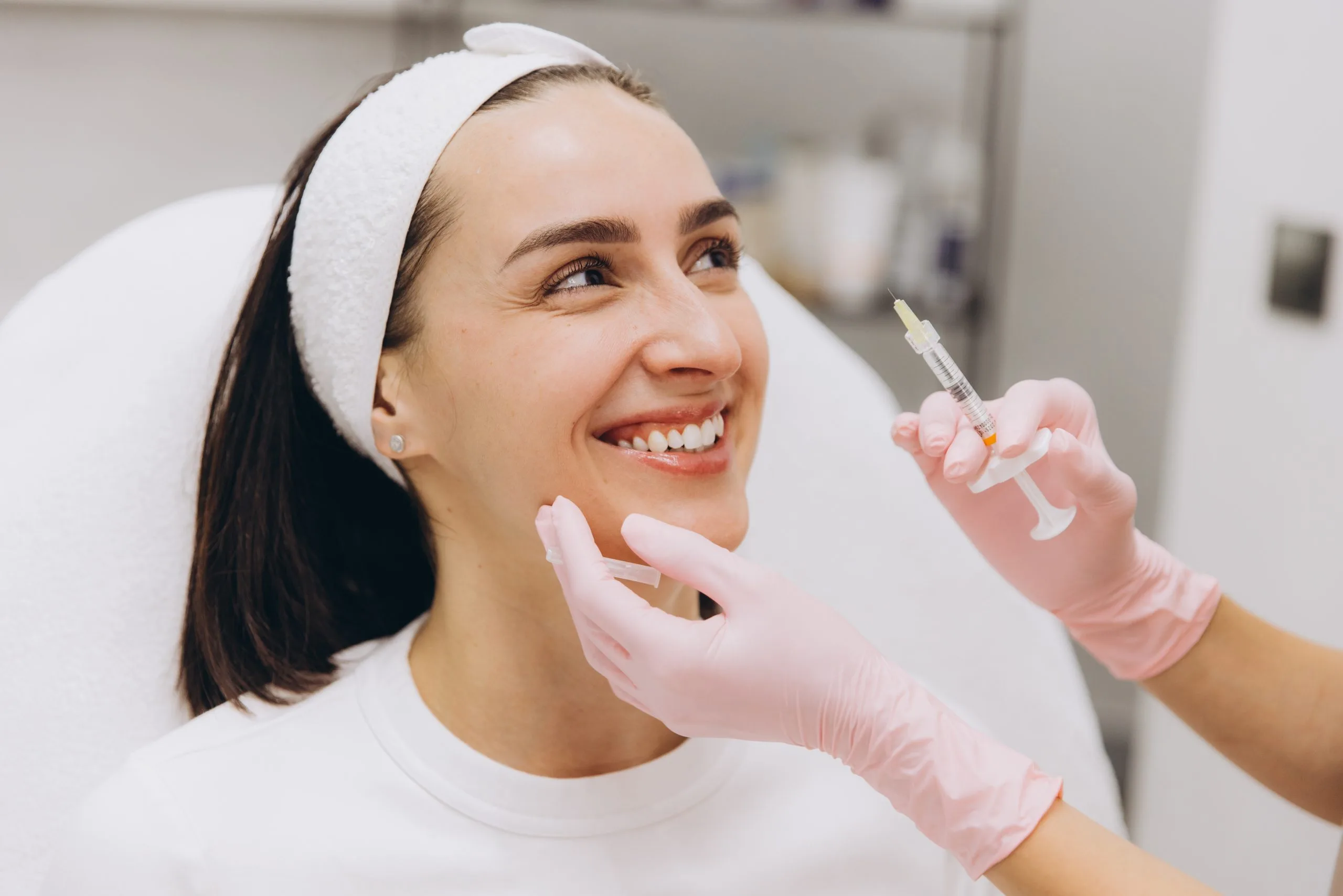
Botox relaxes the muscles that create wrinkles when you move your face, while dermal fillers add volume back to areas that have thinned or hollowed out. If your lines show up when you frown, squint, or raise your eyebrows, Botox is usually the answer. If your lines are visible even when your face is completely still – or your cheeks, lips, or under-eyes look deflated – fillers are typically the better fit.
Many patients benefit from both. Below, we break down how each treatment works, what each can and can’t do, and how to figure out which belongs on your treatment plan.
Think of your face as having two separate aging processes happening at once.
The first is movement-related. Every time you smile, squint against the sun, or concentrate on a screen, specific muscles contract and the skin folds. Over decades, those repeated folds etch into permanent creases – dynamic wrinkles, which respond to neuromodulators like Botox.
The second is volume-related. Starting in your late twenties, your body slowly loses collagen, elastin, hyaluronic acid, and facial fat, and bone density in the face shifts. The result is flattening cheeks, deepening folds, thinning lips, and shadows under the eyes. No amount of muscle relaxing fixes this – you need to replace what’s gone. That’s what dermal fillers do.
Botox is a purified protein derived from botulinum toxin. It has been FDA-approved for cosmetic use since 2002 and is one of the most studied aesthetic treatments in the world. It’s classified as a neuromodulator, meaning it works on the communication between nerves and muscles rather than on the skin itself.
Botox is one of the aesthetic injections offered at Regency Specialties, alongside hyaluronic acid fillers.
When a nerve tells a muscle to contract, it releases a chemical messenger called acetylcholine. Botox temporarily blocks that release at the injection site, so the targeted muscle stays relaxed.
With the muscle at rest, the skin above it stops creasing. Existing lines soften over the following days, and new lines are prevented from deepening. The effect is localized and doesn’t affect sensation in the skin – the goal is never to “freeze” your face, but to soften expressions for a well-rested look.
Botox is used where facial movement drives wrinkling:
Forehead lines – the horizontal bands that appear when you raise your eyebrows
Glabellar lines (“11s”) – the vertical creases between the brows from frowning or concentrating
Crow’s feet – the fan of fine lines radiating from the outer corners of the eyes
Bunny lines – small diagonal creases along the sides of the nose when you scrunch
Chin dimpling – texture and puckering in the chin
Neck bands – vertical cords in the neck from the platysma muscle
Lip flip – a small amount along the upper lip border to gently roll it outward
Botox is also used for a subtle brow lift by relaxing the muscles that pull the brows down, and to reduce excessive underarm sweating.
No. Botox is temporary, and that’s by design. Most patients see their results last three to four months. After that, nerve endings regenerate their connections and muscle movement gradually returns. Duration varies based on the area treated, muscle strength, metabolism, and how much product was used – very active muscles, like the glabella in someone who frowns a lot, sometimes metabolize product faster.
Many long-term patients find they need treatments less often over time. When a muscle is repeatedly relaxed, it can weaken slightly, and the habitual creasing pattern softens. Maintaining results means scheduling on a consistent rhythm rather than waiting until every line has fully returned.
Botox is FDA-cleared with a well-established safety record when administered properly. The most common experiences are minor and short-lived: small red bumps at the injection points that fade within an hour, mild tenderness, swelling, redness, or occasional bruising that resolves in a day or two. Some patients report a brief headache the day of treatment.
The muscles of the face are layered and interconnected, and precise injection depth and location are what separate a natural result from a frozen or asymmetric one. A consultation at Regency Specialties is the first step to confirm you’re a good candidate.
Dermal fillers are injectable gels that restore volume and support beneath the skin. The most widely used fillers – including the Juvéderm family available at Regency Specialties – are made from hyaluronic acid, a sugar molecule your body already produces naturally to hydrate and cushion tissue.
Unlike Botox, fillers don’t affect muscle activity at all. They’re purely additive – and because HA is a substance your body already recognizes, it integrates smoothly for natural-looking results.
Hyaluronic acid has an extraordinary ability to bind water – a single molecule can hold roughly a thousand times its weight. When injected into a specific tissue plane, the gel occupies space and draws in moisture, lifting the skin from underneath and smoothing the surface.
Different formulations have different thicknesses and lifting capacities. A thin gel is right for delicate lip tissue or fine lines around the mouth. A firmer gel is used deep along the cheekbone or jawline where it must hold shape against gravity.
Results are visible immediately, though some swelling settles over one to two weeks as the final shape emerges.
Cheeks and midface – restoring the natural curve and lift that flatters with age
Nasolabial folds – the “smile lines” from the nose to the corners of the mouth
Marionette lines – the lines running down from the mouth corners toward the chin
Lips – adding fullness, defining the border, correcting asymmetry, and smoothing vertical lip lines
Chin – improving projection and balance in profile
Jawline – sharpening definition and softening jowls
Temples – filling hollowing at the sides of the forehead
Under-eye hollows – filling tear troughs to reduce dark circles and a tired look
Backs of the hands – restoring plumpness where tendons and veins show
Fillers address concerns Botox simply cannot touch:
Static wrinkles – lines present when your face is completely relaxed
Volume loss – hollow cheeks, temples, and under-eyes
Facial asymmetry – evening out one side against the other
Contour and structure – creating more definition along the chin and jaw
Lip shape and fullness – adding volume or refining the border
Nose irregularities – smoothing a small dorsal bump non-surgically
Fillers can also stimulate some collagen production in the treated area, improving skin quality beyond the volume effect itself.
Typical post-treatment experiences include swelling, mild bruising, redness, tenderness, and occasional small lumps that settle as the product integrates. These usually subside within several days to a week – lips tend to swell the most, so plan around events for at least a week.
A meaningful advantage of hyaluronic acid is reversibility. An enzyme called hyaluronidase can dissolve the product if the result isn’t what you wanted.
The simplest test you can run at home: look in a mirror with a completely neutral expression. Lines you still see are volume-related and point toward filler. Now make the expression that creates the line you dislike – if it only appears with movement, Botox is the right choice.
Yes – and combining them is extremely common. The two treatments work on entirely different mechanisms, so there’s no conflict, and they’re often performed in the same visit.
A representative plan might include Botox in the forehead, between the brows, and around the eyes, paired with filler in the cheeks and nasolabial folds. The upper face gets smoothed; the mid and lower face get lifted and re-supported.
More complete correction. Aging happens through both movement and volume loss – addressing only one leaves the other visible.
Longer-lasting filler. Reducing repetitive muscle pull over an area of filler may help the product hold its shape longer.
Balanced proportions. Treating the face as a whole avoids one perfectly smooth region next to an untreated one.
Preventive effect. Relaxing the frown muscles keeps deep-set “11s” from worsening while filler smooths any line that remains.
Fewer appointments. Same-visit treatment means one recovery window instead of two.
Progressive results. Filler gives immediate change while Botox develops over two weeks, so improvement keeps unfolding.
Botox relaxes muscles to soften wrinkles caused by facial movement; dermal fillers replace lost volume to smooth lines present at rest and restore contour. Botox lasts three to four months and works mainly on the upper face. Fillers last six to eighteen months and work mainly on the mid and lower face. Combining both addresses the two main drivers of facial aging.
A personalized consultation at Regency Specialties is the most reliable way to determine which combination fits your face and your goals.